The Disability Crisis: Understanding Florida’s Decades-Long Disability Waitlist
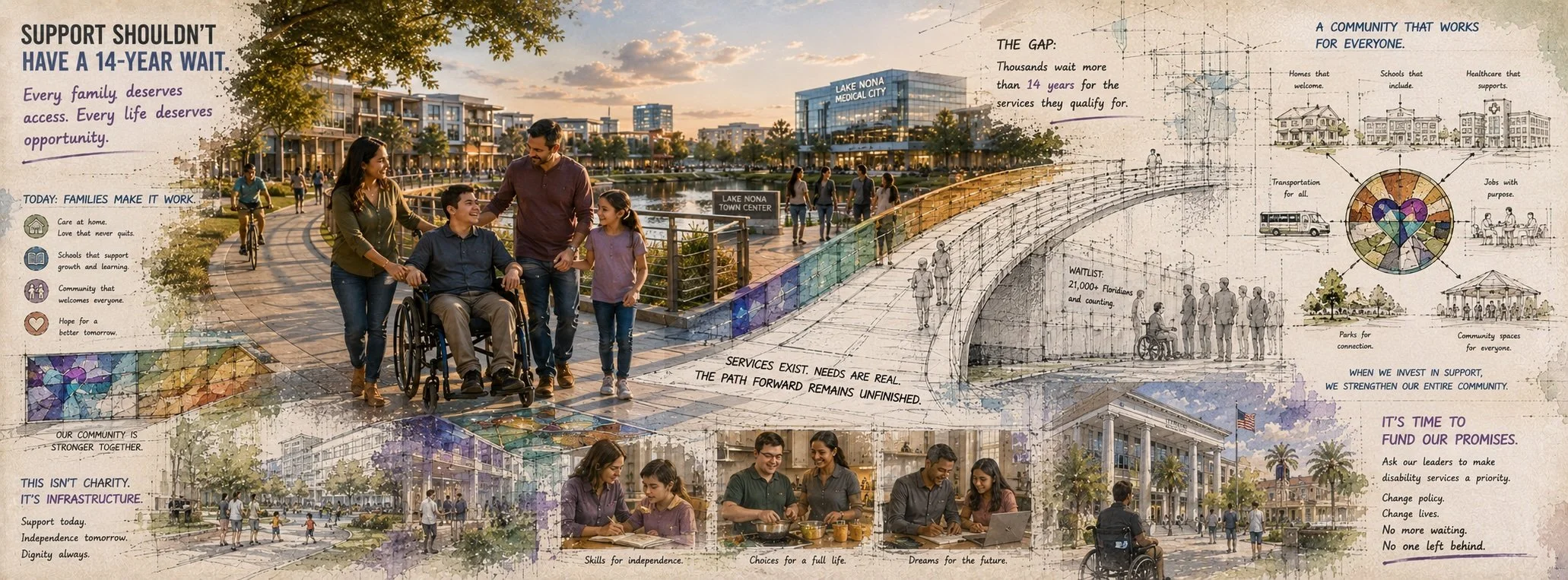
When we talk about the standard of living in Florida, we often focus on our growing economy, tourism, and housing. However, a quiet crisis is unfolding in the background for thousands of our neighbors. In Florida, individuals with severe intellectual and developmental disabilities face a heartbreaking reality: a wait of 14 years or more to receive critical state support services.
As we look toward the upcoming election cycle, understanding this issue—and how state policy shapes it—is essential for every voter in Lake Nona, Orange County, and Florida!.
What is the iBudget Waiver?
The program at the center of this backlog is the Medicaid iBudget Waiver, managed by the Florida Agency for Persons with Disabilities (APD). Unlike standard Medicaid, which covers basic healthcare and doctor visits, the iBudget Waiver covers home- and community-based services. This includes personal care assistance, behavioral therapy, life skills training, and modifications to make homes more accessible.
For a family caring for a child with severe autism, Down syndrome, or cerebral palsy, these services are not luxuries; they are the baseline support needed to live safely and independently.
A System Frozen in "Crisis Mode"
The rumor of a "14-year wait" is not an exaggeration; for many, it is an understatement. The state divides the iBudget pre-enrollment list into seven priority categories.
Categories 1 through 5 are reserved for individuals in immediate crisis—such as children in the foster care system, individuals with extreme medical emergencies, or those whose primary caregivers are over the age of 70. Categories 6 and 7 are for individuals who are currently stable but require long-term assistance.
Because the Florida Legislature caps funding for this program each year, almost all available funds are consumed by emergency cases. If an individual is placed in Category 6 or 7, they do not move up the list simply by waiting their turn. They only move up if their life circumstances deteriorate to the point of crisis. Consequently, individuals frequently languish on this list for a decade or more, effectively frozen out of the system.
Aging Out, Waiting on Care
This policy creates a devastating trajectory for Florida families. A child diagnosed with a developmental disability may be placed on the waitlist at age five. They navigate their school years utilizing public school special education resources. However, when they turn 21 and age out of the school system, those supports vanish.
At that point, they are transitioned to the adult waitlist, where they continue to wait. In many cases, families only receive a waiver slot when the parents reach their 70s or pass away, finally triggering the state’s "crisis" threshold.
A Matter of Legislative Priorities
This backlog is not an inevitability; it is a policy choice. The waitlist consistently hovers around 21,000 to 22,000 Floridians. Historically, Florida ranks near the bottom of the nation—often 49th or 50th—in per-capita spending for intellectual and developmental disability services.
While recent legislative sessions have made modest, incremental investments to move a few hundred people off the list, these efforts have not kept pace with Florida’s rapid population growth.
Why This Matters for the Upcoming Election
As Democrats in Lake Nona, we believe that a community is measured by how it cares for its most vulnerable members. The disability waitlist is a stark reminder of what happens when state budgets prioritize corporate tax cuts over human infrastructure.
In the upcoming election cycle, this must be a frontline issue. We need to ask candidates running for the Florida House and Senate hard questions about their plans for the APD budget. True advocacy means pushing for structural budget changes that systematically fund the iBudget Waiver, with the ultimate goal of eliminating the waitlist entirely.
Families caring for loved ones with disabilities should not have to wait for a family tragedy to get the help they deserve. It is time for Florida to fund its promises.
References
Friedman, C. (2022). A report on the increased payment rates for HCBS for people with intellectual and developmental disabilities during the COVID-19 pandemic. Journal of Developmental and Physical Disabilities, 35(5), 951–970. https://doi.org/10.1007/s10882-022-09886-1 Cited by: 9
FLORIDA, S. D. O. F. (2023). Case 0:12-cv-60460-DMM Document 1170 Entered on FLSD Docket 07/14/2023. FSU College of Law.
Mann, D. R. (2023). Provider solutions for people with IDD environmental scan report. Florida Developmental Disabilities Council. Cited by: 1
Muthalaly, K. (2021). SOAR partners IDD waitlist research. Digital Showcase.
