Lines in the Sand - Understanding Gerrymandering
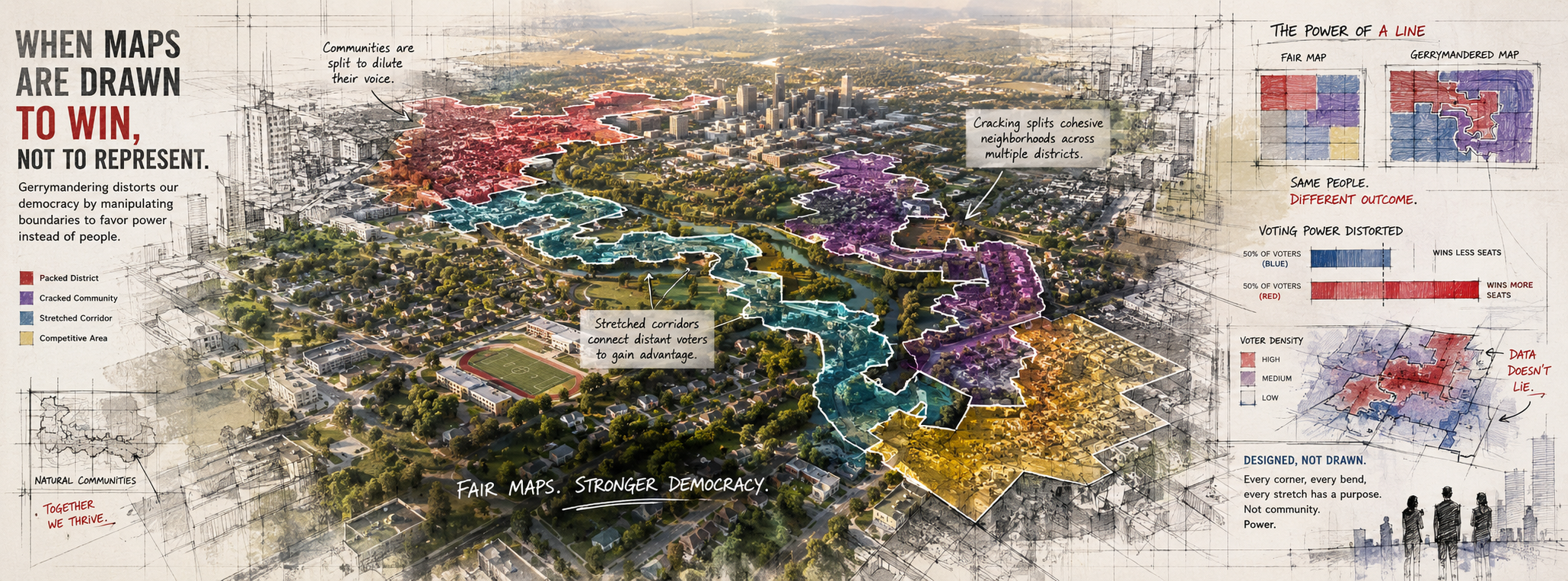
If you have ever looked at a political map of Florida and thought, "Why does that district look like a squiggly snake?" you have likely observed gerrymandering in action. It is an issue that directly impacts our voting power right here in Central Florida and the entire state.
As we work to build a more representative democracy, understanding how these lines are drawn—and how they impact our community—is step one.
What is Gerrymandering?
Simply put, gerrymandering is the practice of redrawing the boundaries of legislative districts to give one political party an unfair advantage over another. The term dates all the way back to 1812, when Massachusetts Governor Elbridge Gerry signed a bill creating a partisan district shaped so strangely it looked like a salamander. A local newspaper dubbed it the "Gerry-mander," and the name stuck.
Instead of politicians competing for your vote based on their ideas, gerrymandering allows politicians to choose their voters.
How—and Why—Parties Use It
Gerrymandering isn't accidental; it is a highly precise, data-driven political strategy. Mapmakers typically use two main tactics:
Packing: Cramming as many voters of the opposing party into a single district as possible. While that opposing party will likely win that one seat, their voting power is completely diluted in all the surrounding districts.
Cracking: Splitting a cluster of like-minded voters across multiple different districts. By breaking them up, they never form a majority anywhere, effectively silencing their collective voice.
Why do political parties do this? Because it creates "safe seats." When a district is engineered to guarantee a win for one party, politicians no longer have to worry about appealing to a broad, moderate base. This drives extreme polarization and leaves regular voters feeling like their ballots don't actually count.
Why It Matters for Our Community
When communities like Lake Nona and the greater Southeast Orlando area are split up or grouped into wildly mismatched districts, our collective leverage shrinks. We need representation that understands our unique local needs—like managing infrastructure growth and funding local schools.
Want to Learn More?
Democracy works best when it is transparent. If you want to dive deeper into the fight for fair maps, here are some resources you can explore:
The Brennan Center for Justice: A nonpartisan law and policy institute that offers deep-dive articles, legal breakdowns, and tracking tools on redistricting across the country.
Princeton Gerrymandering Project: An incredible data-driven resource that uses math and statistics to grade state maps on how fair—or biased—they actually are.
All On The Line: A national grassroots campaign devoted entirely to ending gerrymandering and restoring fairness to our redistricting process.
The best way to fight back? Stay informed, spread the word, and make your voice heard at the ballot box!
*Please note that the political map rendering does not reflect an actual map of Florida districts. Those maps can be obtained at flsenate.gov or flhouse.gov